Robotics & Liquid Handling
The HIPS Technology Robotics and Liquid Handling platform is a state-of-the-art infrastructure for automated sample storage and processing. It combines high-performance automated freezer units, a central automated liquid-handling workstation, and complementary liquid-handling systems into an integrated platform for efficient and reproducible workflows.
A key component is the Beckman Coulter Echo 650T, which enables contactless liquid transfer in the nanoliter range. This allows for highly resource-efficient processes and enables large-scale high-throughput screening at HIPS for the first time.
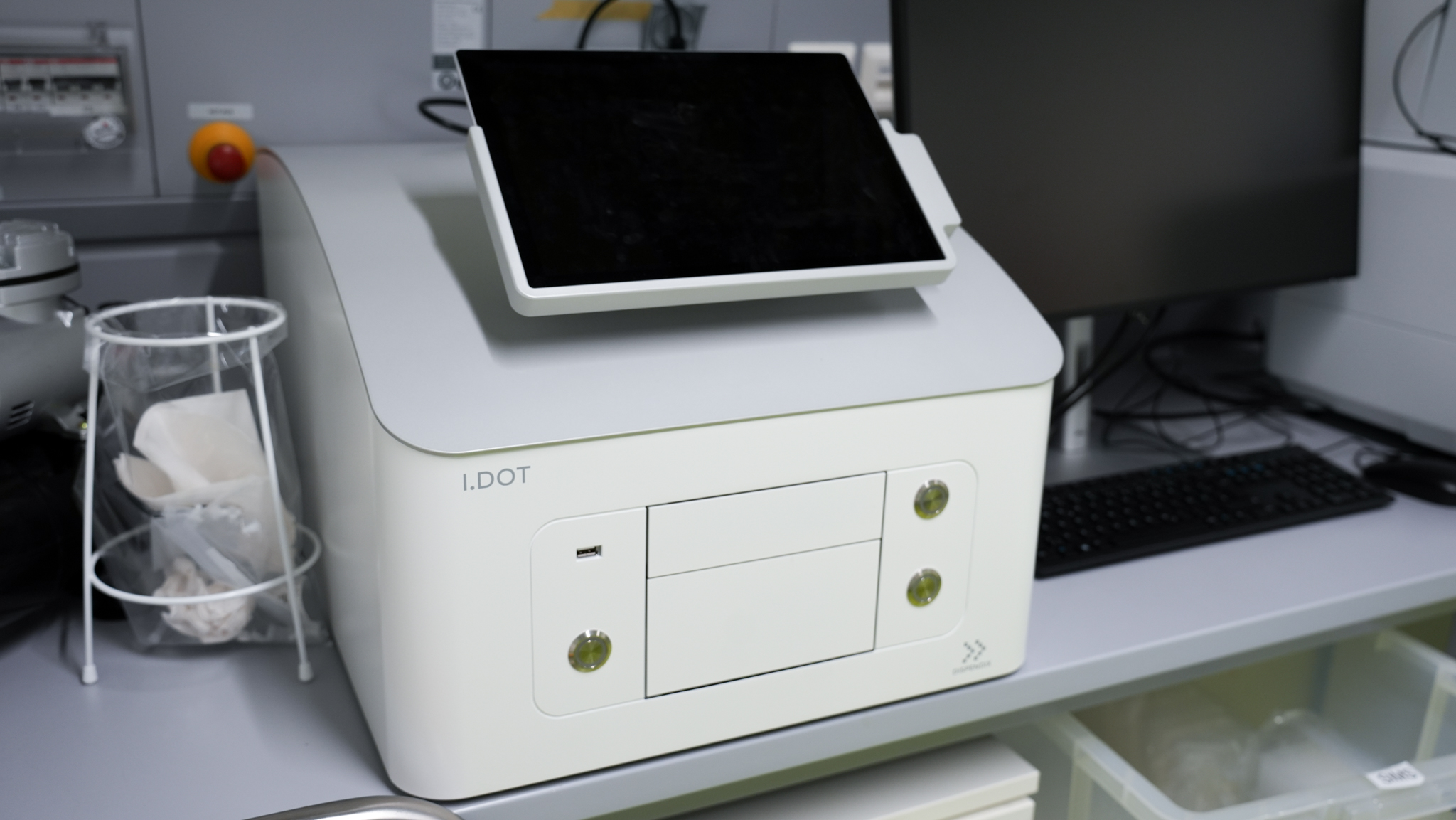
The infrastructure is complemented by the Alpha-Build high-throughput pipeline, which enables the automated miniaturization of cloning, transformation, and assay processes at the nanoliter scale. It integrates the CyBio FeliX for DNA delivery, the Dispendix i.Dot for precise liquid handling, and a RapidFire MS system (see HIPS Technologies Analytics) for rapid analytical evaluation, thereby enabling a seamless, automated workflow from design to analysis.
The facility is used for the storage of library samples and strain collections (compounds, extracts, fractions, plasmids, (myxo)bacterial strains, and GMOs), as well as for the automated preparation of assay and screening plates, which can be analyzed in high-throughput bioactivity screening assays.
A significant portion of the equipment was funded by the European Regional Development Fund (EFRE) as well as by state funding from Saarland.



Contact person


Automated Freezers
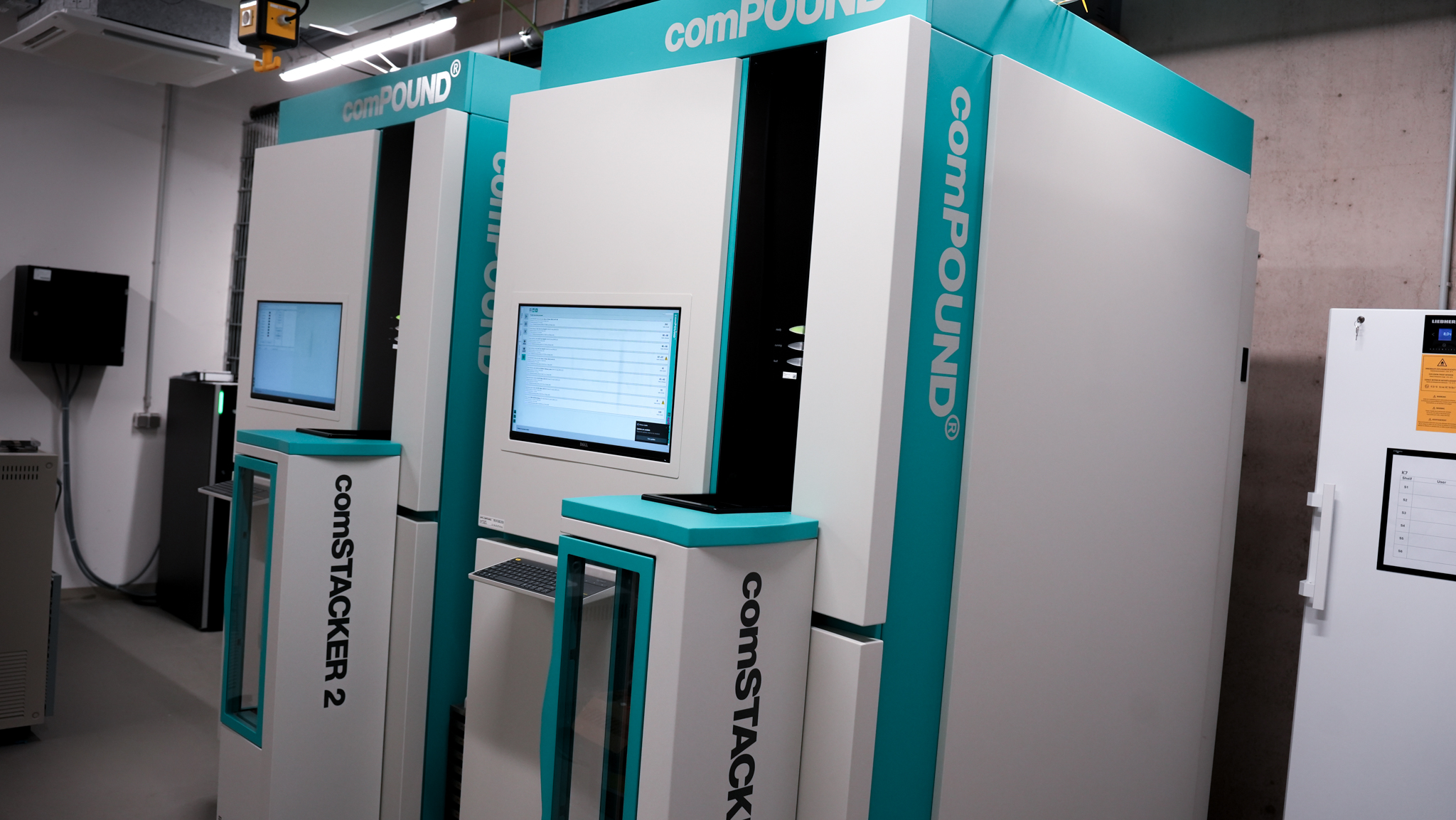
SPT Labtech comPOUND and arktic Freezers
The automated freezers SPT Labtech comPOUND (-20 °C, 2 units) and SPT Labtech arktic (-80 °C, 1 unit) provide centralized, fully automated storage of large sample libraries.
The systems use robotic storage logistics within temperature-controlled units. Vials are stored rack-free directly in the system – in carousels (comPOUND) or metal tubes (arktic). A compressed air-based transport system enables precise positioning and fast random-access retrieval of individual vials without relocating others.
Requests are software-controlled, barcode-based, and fully documented. As the starting point of the screening workflow, the systems automatically supply samples for downstream processes.
Key features:
- Direct single-vial access (random access) or serial access
- Reduced freeze–thaw cycles
- High-density storage with rapid access
- Barcode-based traceability (HIPSbase)
- High system reliability (redundancy, UPS, monitoring, backup systems)
- For up to ~470,000 samples


Liquid Handling
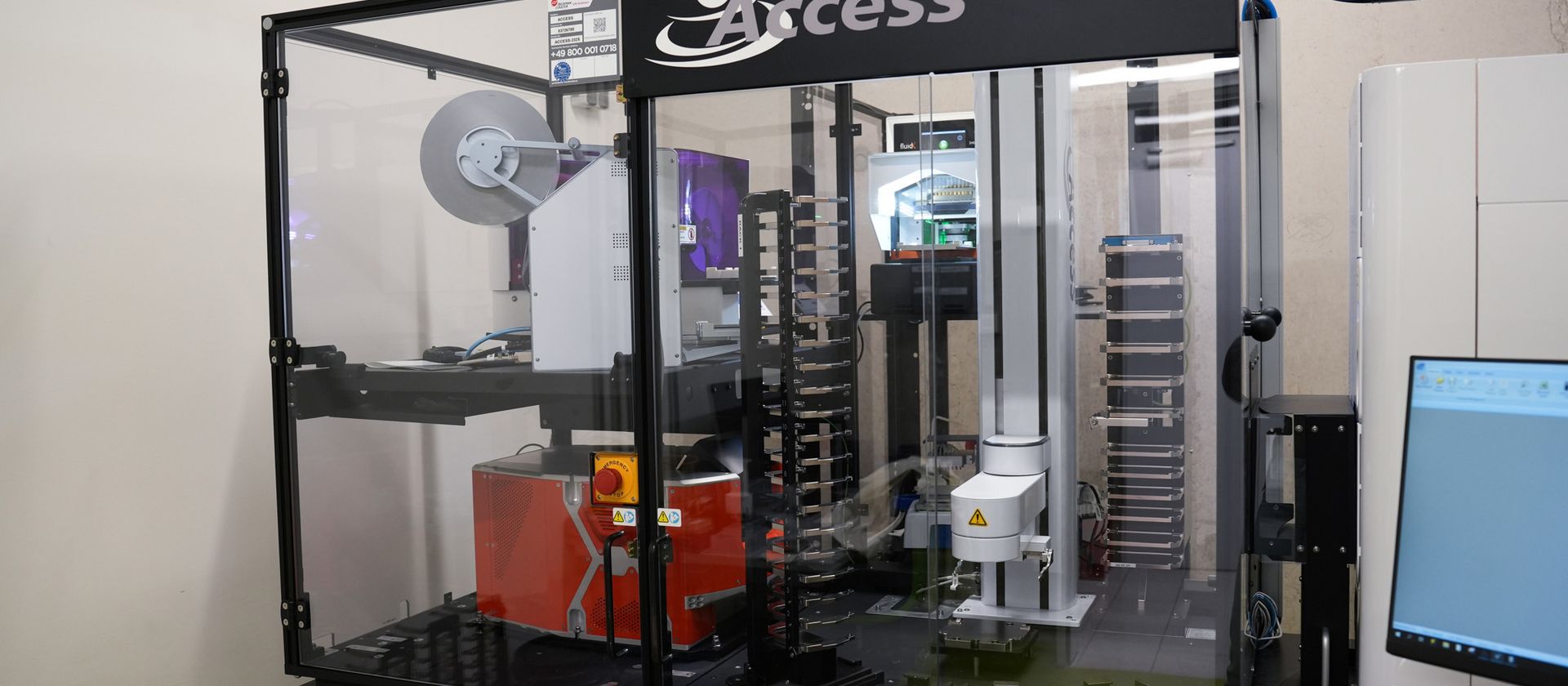
Echo Access Workstation with Beckman Coulter Echo 650T
The Echo Access Workstation is a highly automated liquid-handling platform for generating assay and screening plates in the nanoliter range. Its core component is the Beckman Coulter Echo 650T for contactless liquid transfer.
Transfer is performed acoustically using focused ultrasonic pulses that eject defined droplets without contact. Volumes from 2.5 nL to 2 µL enable highly precise dispensing without pipette tips. Any-to-any transfers and direct dilutions provide maximum flexibility without layout or dilution constraints. Dynamic Fluid Analysis automatically adjusts parameters to liquid properties.
Integrated modules (e.g., dispenser, sealer, centrifuge, capper/decapper) are robotically connected, enabling seamless automated workflows. The workstation processes samples from freezers into ready-to-use assay plates and represents the core of the screening workflow.
Key features:
- Contactless acoustic transfer (2.5 nL – 2 µL)
- Tip-free operation, reduced plastic consumption
- Any-to-any transfers without layout constraints
- Direct dilutions without serial steps
- Automatic adaptation to liquid properties
- High precision and reproducibility
- Fully automated workflows (screening, genomics, proteomics)


Integra Viaflo 384
The Integra Viaflo 384 is a liquid-handling system for microliter-scale processing and automated plate reformatting (0.5–1,250 µL).
The system uses electronically controlled multichannel pipettes with liquid-class control to ensure reproducible handling of different liquid types. Samples are transferred in parallel from source to destination plates. Automated protocols enable flexible reformatting, including direct 96- to 384-well conversion.
The Viaflo performs preparatory steps prior to nanoliter processing in the Echo system and standardizes sample formats within the workflow.
Key features:
- Volume range 0.5–1,250 µL
- Automated plate reformatting (e.g., 96 → 384 well)
- Liquid-class-based, reproducible pipetting
- Parallel multichannel processing for high efficiency
- Processing of up to 96 tubes simultaneously
- Reduced manual pipetting steps
- Central interface between tube- and plate-based formats

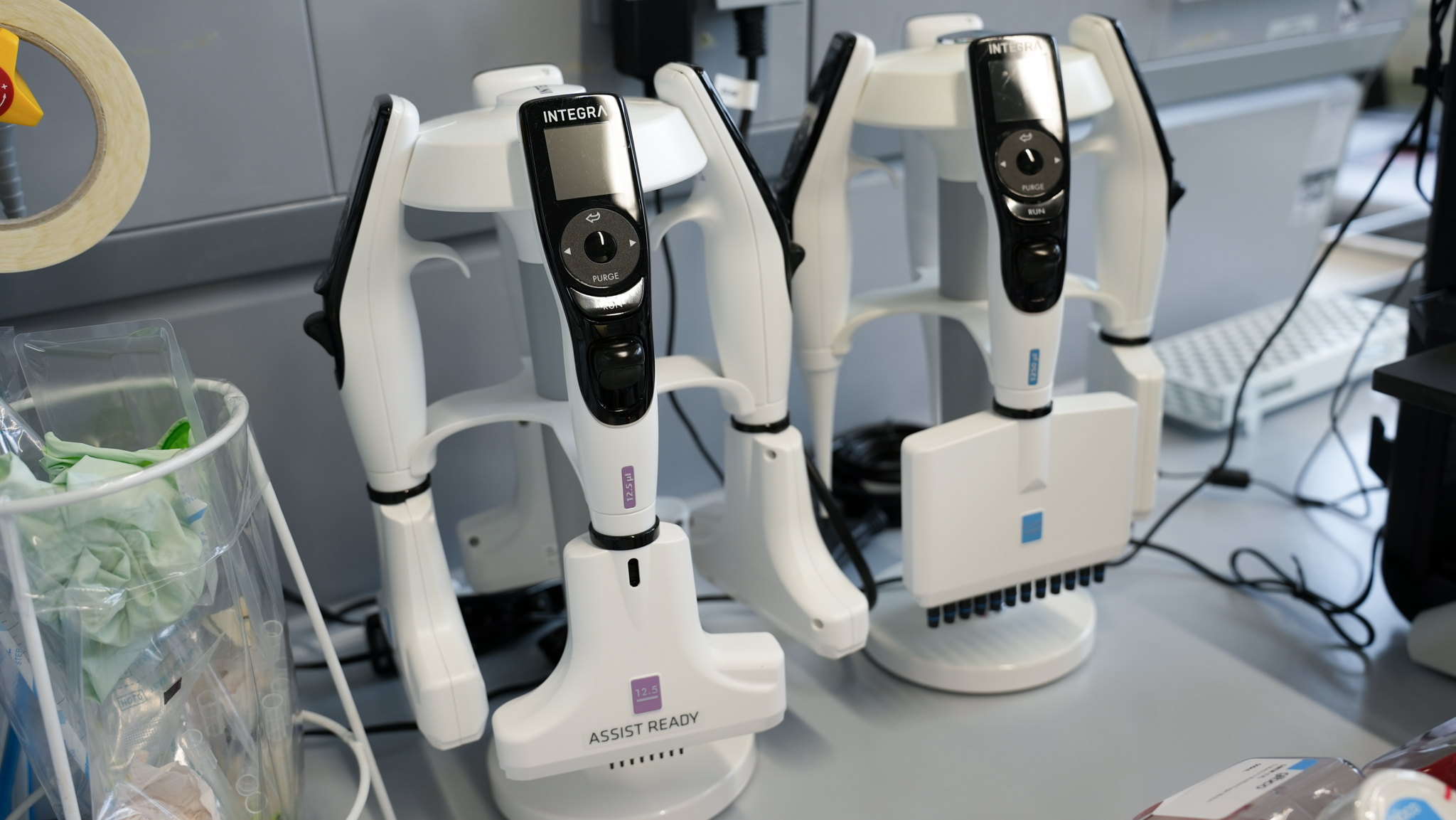
Integra Assist Plus
The Integra Assist Plus is a compact automation system supporting manual pipetting processes in the volume range of 0.5–1,250 µL.
The system combines an automated pipetting platform with motorized positioning. The integrated Voyager multichannel pipette allows adjustable tip spacing for different plate formats at the push of a button. The D-One single-channel module enables precise individual pipetting, e.g., for cherry picking. Larger volumes can also be handled using reservoirs.
The Assist Plus is used for flexible, standardized pipetting steps and serves as an interface between manual and automated processes within the workflow.
Key features:
- Volume range 0.5–1,250 µL
- Adjustable tip spacing (96-/384-well without reconfiguration)
- Combination of multichannel and single-channel pipetting
- Precise cherry picking and flexible layouts
- Reservoir-based processing for larger volumes
- Easy operation without programming
- Reduced errors and improved reproducibility

Automated Bioactivity Screening
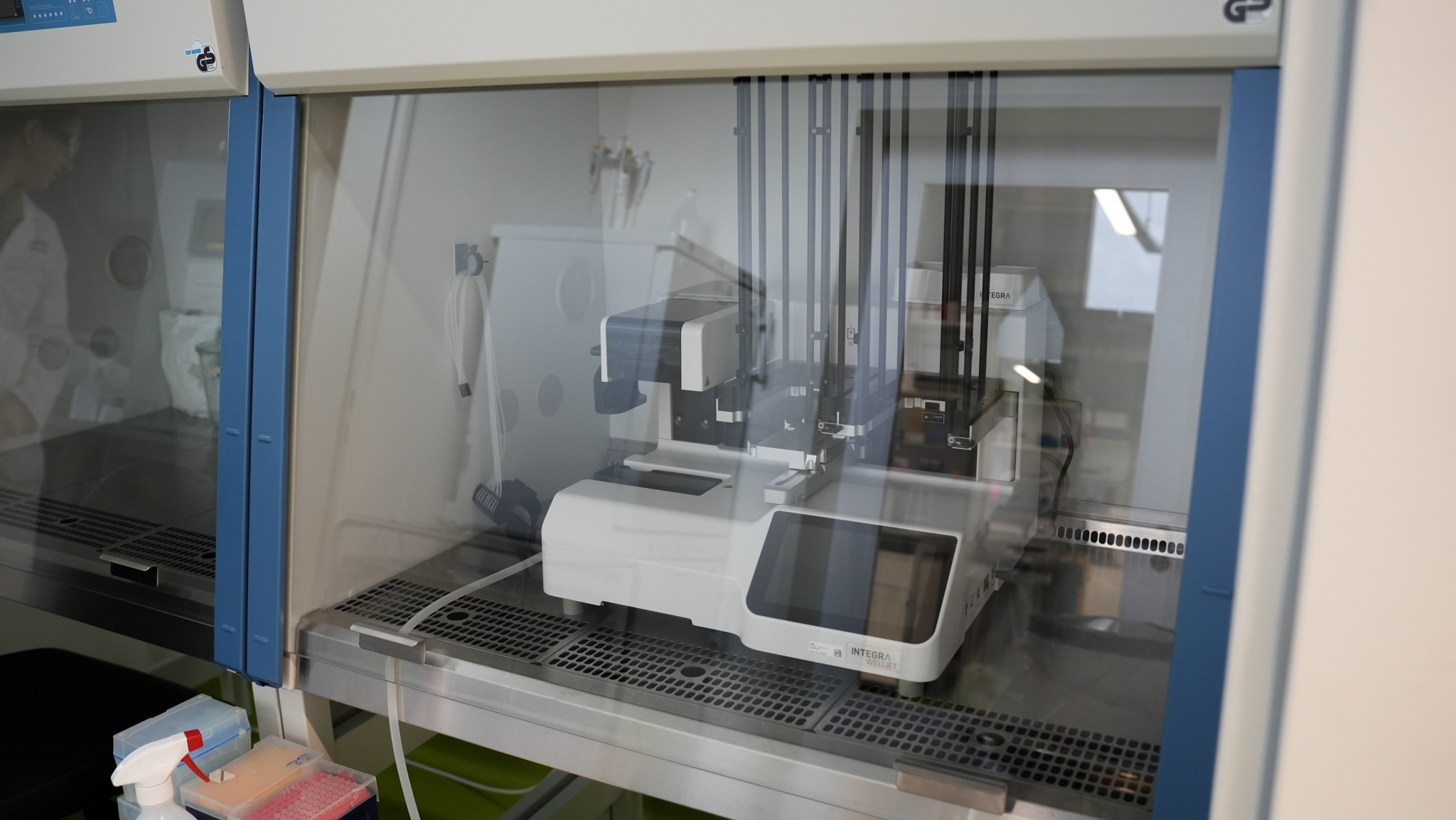
Integra Welljet with Stacker
The two Integra Welljet systems are used for automated dispensing of media, reagents, and cell suspensions into microtiter plates (0.5 µL – 10 mL). The integrated stacker enables continuous processing of up to 50 plates.
Dispensing is performed via a pressure-based multichannel system, ensuring uniform distribution and low-shear handling to protect sensitive cells. The stacker enables uninterrupted, automated workflows with consistent throughput.
The systems are used for standardized preparation of assay and screening plates in medium- to high-throughput applications.
Key features:
- Volume range 0.5 µL – 10 mL
- Automated multichannel dispensing
- Uniform distribution across all wells
- Low-shear, cell-friendly dispensing
- Integrated stacker (up to 50 plates)
- Continuous, uninterrupted workflows
- High throughput and reproducibility
Tecan Spark with Barcode Scanner and Stacker
The Tecan Spark is a multimode plate reader for automated analysis of screening experiments. The integrated stacker enables continuous processing of up to 30 plates.
The system supports a wide range of optical assays, including absorbance, fluorescence, FRET, AlphaScreen/AlphaLISA, as well as luminescence and kinetic measurements. Plates are automatically fed and uniquely identified via barcode.
Measurements are fully automated and controlled by integrated software combining instrument control, data analysis, and QC. Results are directly transferred to the HIPSbase database. The Spark represents the analytical endpoint of the screening workflow.
Key features:
- Multimode detection (absorbance, fluorescence, FRET, AlphaScreen/AlphaLISA, luminescence)
- Kinetic and time-resolved measurements
- Integrated stacker (up to 30 plates)
- Automated barcode identification
- Fully automated measurement and data analysis
- High throughput and standardized evaluation
- Direct integration into HIPSbase (traceability)
Synergy H1 Multi-Detektions-Platereader (Agilent)
The Agilent Synergy H1 is a multi-detection plate reader for analyzing biological samples in 96- and 384-well plates. At HIPS, it is mainly used for long-term and kinetic assays.
The system combines absorbance, fluorescence, and luminescence detection with integrated shaking incubation. Samples are kept in motion at controlled temperature over extended periods, with measurement cycles automatically paused and resumed.
The Synergy H1 enables continuous experiments for up to 96 hours and supports monitoring of growth and bioactivity, e.g., in antibiotic screening. It complements existing screening and liquid-handling platforms.
Key features:
- Multimode detection (absorbance, fluorescence, luminescence)
- Integrated shaking incubation for long-term measurements
- Continuous experiments up to 96 h (24/7 operation)
- Kinetic measurements and growth curves (e.g., OD600)
- High stability and precision in continuous operation
- Compatible with 96- and 384-well formats
- Flexible integration into HTS workflows
Capper und Decapper
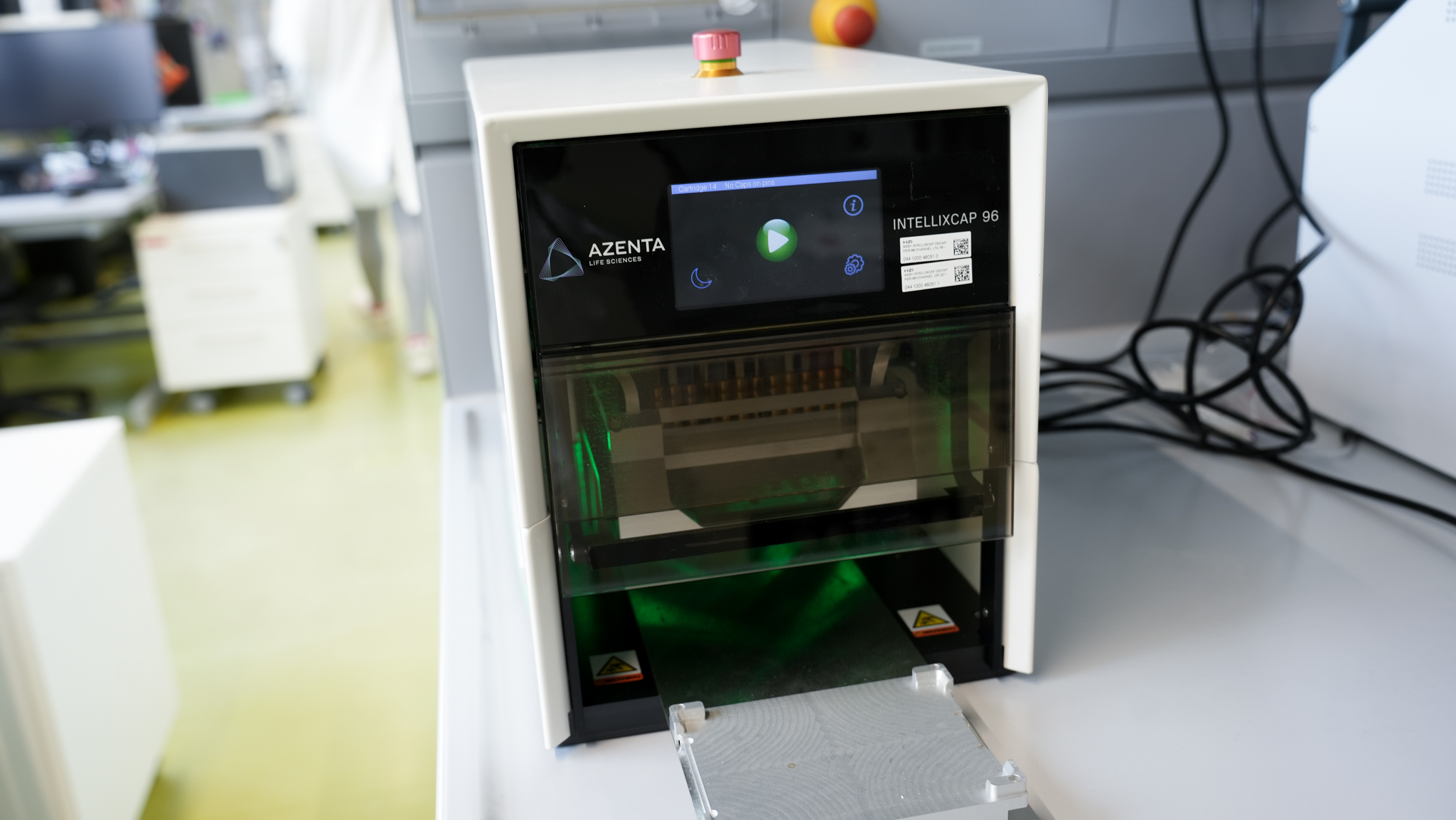
Azenta IntelliXcap 96 Capper and Decapper
The Azenta IntelliXcap 96 is an automated system for opening and closing 96-tube racks.
The system uses synchronized gripping and rotation mechanisms to process all tubes in parallel. Interchangeable cartridges allow flexible handling of different closure types. Controlled torque ensures reproducible and secure sealing.
The IntelliXcap supports sample logistics between storage, liquid handling, and screening within the workflow.
Key features:
- Parallel opening and closing of full 96-tube racks
- Interchangeable cartridges for different closure types
- Defined torque control for secure sealing
- Prevention of evaporation and leakage
- High throughput via parallel processing
- Reduced manual handling steps
High-Troughput-Barcode-Scanner
Azenta/Ziath Mirage Rack Barcode-Scanner
The two Ziath Mirage systems are high-throughput barcode scanners for rapid capture of complete 96-tube racks.
The systems use camera-based imaging technology to simultaneously read all 2D barcodes. Decoding is performed using Cyclops and DP5 software for fast and reliable data visualization.
Integrated non-freeze technology enables direct scanning of frozen samples without condensation, ensuring stable operation under cold-chain conditions.
The scanners enable digital sample capture and traceability within sample logistics prior to downstream processes.
Key features:
- Simultaneous scanning of full 96-tube racks
- Camera-based 2D barcode detection
- Fast decoding (Cyclops & DP5 software)
- Non-freeze technology for frozen samples
- No condensation, stable cold-chain operation
- High efficiency for large libraries
- Full sample traceability
Heat-Sealing-System
Agilent PlateLoc Sealer
The Agilent PlateLoc Sealer is an automated heat-sealing system for sealing microtiter plates and stabilizing samples within the screening workflow.
The system seals plates using controlled heat and pressure, applying a specialized film that ensures uniform and tight sealing of all wells. The foil is peelable and pierceable and compatible with downstream processes such as the Echo Access Workstation and LC-MS analytics.
The PlateLoc Sealer is used to stabilize assay and screening plates prior to incubation, storage, or analysis.
Key features:
- Automated heat sealing of microtiter plates
- Uniform and reproducible sealing of all wells
- Protection against evaporation and contamination
- Peelable and pierceable sealing films
- Direct integration into Echo and LC-MS workflows
- No additional opening or transfer steps required
- Increased process reliability and efficiency

Alpha-Build Pipeline
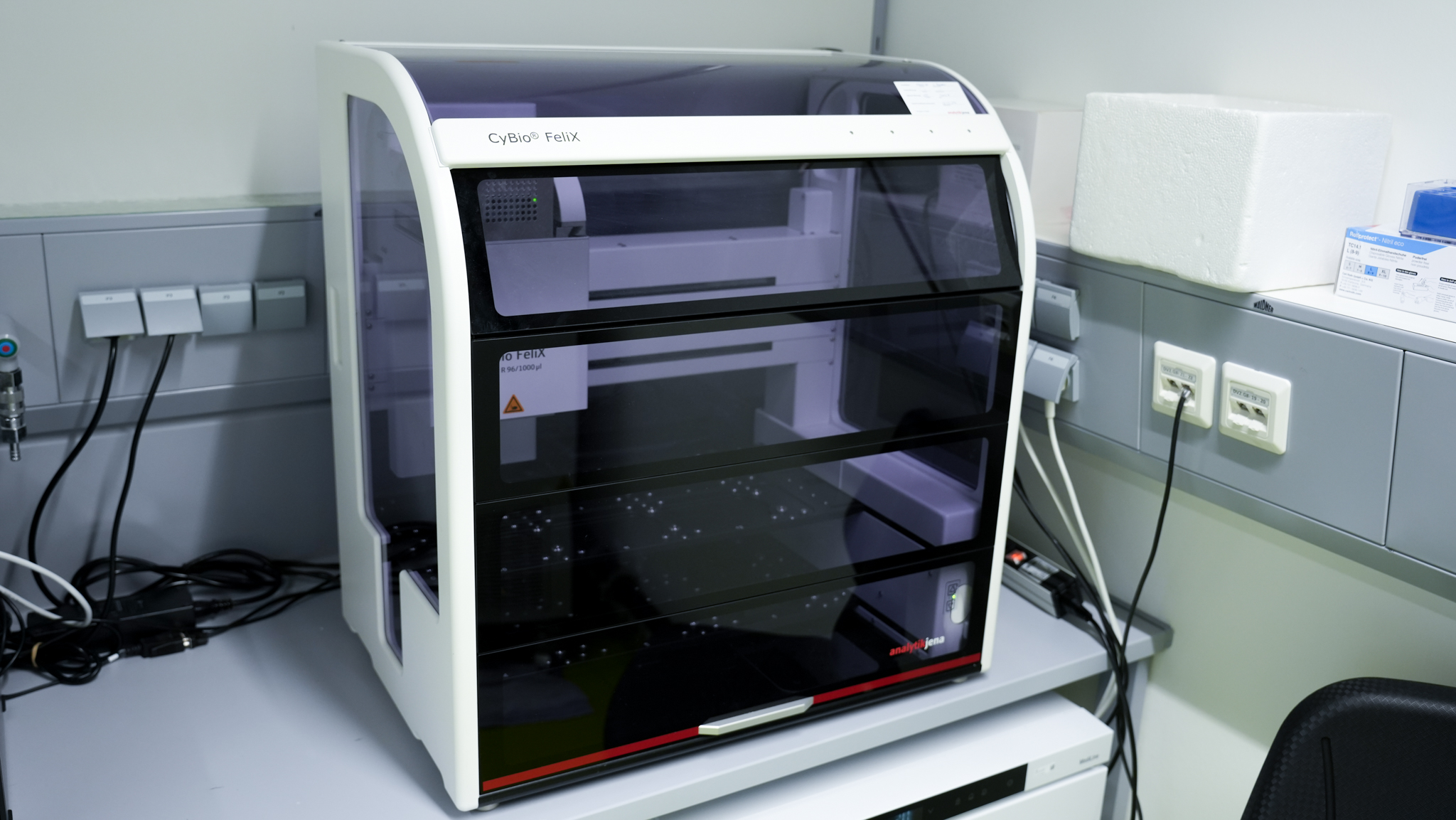
CyBio FeliX
The CyBio FeliX is a modular liquid handler for automated sample preparation and serves as the starting point of the Alpha-Build pipeline.
The system enables precise liquid handling in the range of 1–1000 µL and supports key workflows such as plasmid and gDNA extraction, PCR setup, normalization, and preparation of bacterial extracts. Automated tool and tip exchange, combined with modular pipetting heads, allows flexible and scalable workflows with seamless integration into downstream systems.
The CyBio FeliX provides standardized DNA input for the I.DOT S and delivers reproducible samples for RapidFire MS analysis, thereby defining data quality across the entire design–build–test–learn pipeline.
Key features:
- Volume range 1–1000 µL
- Automated DNA and sample preparation (plasmid, gDNA, PCR)
- Modular design with interchangeable pipetting heads
- Automated tool and tip exchange
- High reproducibility for AI-driven workflows
- Integration into end-to-end pipeline (FeliX → I.DOT S → RapidFire)
- Reduced reagent and plastic consumption (miniaturization, reusable components)
Dispendix I.DOT S
The Dispendix I.DOT S is a contactless nanoliter liquid handler for highly precise dispensing of ultra-low volumes and represents the core component of the Alpha-Build pipeline.
The system uses a non-contact, pressure-based dispensing technology, enabling accurate transfer of volumes from 0.1 nL to 30 µL. Eight parallel valves ensure high-speed dispensing, while integrated optical drop detection verifies each individual droplet. Any-well-to-any-well capability allows maximum flexibility without layout constraints.
The I.DOT S performs assembly and reagent dispensing between DNA preparation (CyBio FeliX) and analytics (RapidFire MS).
Key features:
- Contactless dispensing (0.1 nL – 30 µL)
- Optical drop detection (high accuracy tracking)
- 8 parallel dispensing channels for high throughput
- Any-well-to-any-well transfers without layout constraints
- Fast nanoliter dispensing
- No cross-contamination (tip-free operation)
- Strong assay miniaturization