

Natural products from underexplored pathways and extreme environments
Dr Florian Hubrich
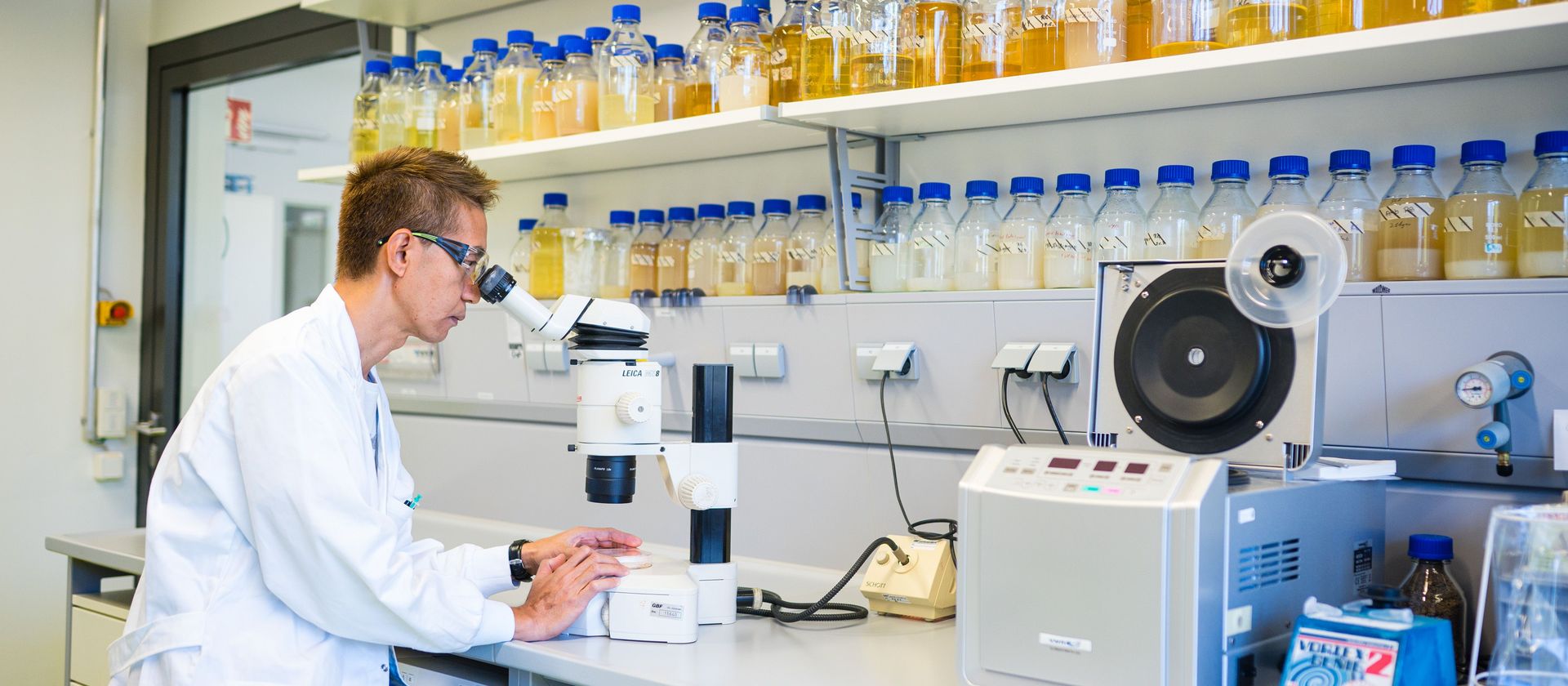
Drugs with new chemical entities are urgently needed to tackle the emerging antibiotic resistance. We investigate natural products from underexplored pathways and extreme environments to characterize bioactive molecules with true structural novelty and their biosynthetic enzymes to bioengineer and improve potent anti-infectives.
Our research and approach
Natural products exhibit versatile bioactivities and provide valuable lead structures for drug discovery. Although the total number of characterized natural products increased over the last decades, only few of the compounds discovered had previously unknown chemical structures. However, structurally new chemicals are urgently required for the development of antibiotics with resistance-breaking properties and other active drugs. Recent advances in the field of natural product discovery indicate that there are several promising avenues to detect bioactive natural products with new chemical entities. The wealth of publicly available (meta)genomes conceals significant biosynthetic potential that has yet to be elucidated. In addition, there is an increasing number of talented microbial natural product producers that have been isolated but remain underexplored. Moreover, the isolation of natural products from habitats and organisms thought to lack the potential for natural product biosynthesis (e.g. hot sulfur springs) further supports the hypothesis that the known natural product chemical space covers only the tip of the iceberg.
The Hubrich Lab aims to contribute to the expansion of the currently known natural product chemical diversity and to characterize the biosynthetic enzymes involved. The resulting compounds and enzymes will be used to develop and improve anti-infectives through bioengineering. To achieve this goal, metabolic pathways of talented but neglected natural product producers such as cyanobacteria and microbes that colonize extreme habitats will be investigated. The research approach applies interdisciplinary methods of modern natural product research and chemical biology, including bioinformatics, molecular and synthetic biology, microbiology, enzymology and (bio)synthetic chemistry.
Team members

Dr Florian Hubrich
Group Leader

Alexander Major
PhD Student

Julia Hill
PhD Student

Leon Schwarz
PhD Student

Yihai Yan
PhD Student
Research projects
Biosynthetic generation of non-natural antimicrobial lipopeptides
Peptide lipidation is valuable by improving the therapeutic and bioactive properties of peptides. All approved lipopeptide drugs are acylated which can cause cytotoxic effects. Genome mining suggests a treasure-trove of non-acylated lipopeptides to discover, for instance with isoprenoid moieties. Today, there are only a few characterized peptide prenyltransferases (PTs). Prenylated peptides are reported to possess the beneficial therapeutic properties of lipopeptides without sharing the toxicity. Unfortunately, no general understanding about the influence of prenylation at different amino acids or with various isoprenoid donors is currently available. We aim to fill in this gap by expanding the characterized PTs involved in lipopeptide natural product biosynthesis. To reach this goal, we establish a “plug-and-play” PTs library and examine the influence of distinct prenylated amino acids for the bioactivity of target peptides against multi-resistant bacteria. Based on this knowledge, we want to engineer efficient biocatalysts and apply them for lipopeptide (bio)synthesis to obtain new candidates for antimicrobial drug development.
Exploring the (bioactive) natural product biosynthesis of Thermovibrio ammonificans
Natural products are beneficial chemical molecules for their producers, e.g., for defense. Due to their very specific lifestyle and often small genomes, bacteria colonizing extreme habitats were longtime expected to be unable to produce natural products. However, there are a few natural products isolated from such environments but the biosynthesis remained enigmatic. With funding of the Klaus Tschira Boost Fund, we aim to decipher the biosynthesis of ammonificins, bioactive natural products produced by the anaerobic hydrothermal vent bacterium T. ammonificans. Using a combination of methods from synthetic biology, microbiology and molecular biology we aim to understand how the extremophile produces the unique chemical scaffolds and harness the biosynthetic enzymes and natural products to tackle emerging challenges such as antimicrobial resistance.
Publications
2026
Discovery, engineering, and applications of amino acid and peptide prenyltransferases
Hubrich F (2026)
Nat. Prod. Rep.DOI: 10.1039/D5NP00075K
2024
Ribosomal peptides with polycyclic isoprenoid moieties
Hubrich F, Kandy S, Chepkirui C, Padhi C, Mordhorst S, Moosmann P, Zhu T, Gugger M, Chekan J, Piel J (2024)
Chem 10 (10): 3224-3242
2022
Biosynthetic potential of the global ocean microbiome
Paoli L, Ruscheweyh H, Forneris C, Hubrich F, Kautsar S, Bhushan A, Lotti A, Clayssen Q, Salazar G, Milanese A, …, Piel J, Sunagawa S (2022)
Nature 607 (7917): 111-118DOI: 10.1038/s41586-022-04862-3
Biosynthesis of Menaquinone in E. coli: Identification of an Elusive Isomer of SEPHCHC
Fries A, Mazzaferro L, Bisel P, Hubrich F, Andexer J, Müller M (2022)
ChemBioChem 23 (18)DOI: 10.1002/cbic.202200181
Widespread microbial utilization of ribosomal β-amino acid-containing peptides and proteins
Scott T, Verest M, Farnung J, Forneris C, Robinson S, Ji X, Hubrich F, Chepkirui C, Richter D, Huber S, …, Bode J, Piel J (2022)
Chem 8 (10): 2659-2677
Ribosomally derived lipopeptides containing distinct fatty acyl moieties
Hubrich F, Bösch N, Chepkirui C, Morinaka B, Rust M, Gugger M, Robinson S, Vagstad A, Piel J (2022)
Proc. Natl. Acad. Sci. U.S.A. 119 (3)DOI: 10.1073/pnas.2113120119
2021
Uncovering Novel Peptide Chemistry from Bacterial Natural Products
Hubrich F, Lotti A, Scott T, Piel J (2021)
Chimia (Aarau) 75 (6): 543-547DOI: 10.2533/chimia.2021.543
Chorismate- and isochorismate converting enzymes: versatile catalysts acting on an important metabolic node
Hubrich F, Müller M, Andexer J (2021)
Chem. Commun. (Camb) 57 (20): 2441-2463DOI: 10.1039/d0cc08078k
2019
Chorismatases - the family is growing
Grüninger M, Buchholz P, Mordhorst S, Strack P, Müller M, Hubrich F, Pleiss J, Andexer J (2019)
Org. Biomol. Chem. 17 (8): 2092-2098DOI: 10.1039/c8ob03038c
2015
Chorismatase Mechanisms Reveal Fundamentally Different Types of Reaction in a Single Conserved Protein Fold
Hubrich F, Juneja P, Müller M, Diederichs K, Welte W, Andexer J (2015)
J. Am. Chem. Soc. 137 (34): 11032-7DOI: 10.1021/jacs.5b05559
2014
Mechanistic implications for the chorismatase FkbO based on the crystal structure
Juneja P, Hubrich F, Diederichs K, Welte W, Andexer J (2014)
J. Mol. Biol. 426 (1): 105-15DOI: 10.1016/j.jmb.2013.09.006
In vitro production and purification of isochorismate using a two-enzyme cascade
Hubrich F, Müller M, Andexer J (2014)
J. Biotechnol. 191: 93-8DOI: 10.1016/j.jbiotec.2014.06.003
2013
Cinnamic acid derivatives as inhibitors for chorismatases and isochorismatases
Hubrich F, Mordhorst S, Andexer J (2013)
Bioorg. Med. Chem. Lett. 23 (5): 1477-81DOI: 10.1016/j.bmcl.2012.12.059
2011
Engineering the respiratory complex I to energy-converting NADPH:ubiquinone oxidoreductase
Morina K, Schulte M, Hubrich F, Dörner K, Steimle S, Stolpe S, Friedrich T (2011)
J. Biol. Chem. 286 (40): 34627-34DOI: 10.1074/jbc.M111.274571